Starting a Vending Machine Business? Use the 30-30 Rule
Are you searching for a proven way to generate steady passive income? Building a vending machine business offers high profit margins, flexible working hours, and scalable cash flow.
However, jumping in without a strict operational framework can prove costly. Most beginners fail because they buy expensive machines first and then drive hours out of their way to service low-volume locations. That is where "The 30-30 Rule" comes in—a core operational blueprint designed to protect your capital, optimize your route density, and maximize your profit per hour.
In this comprehensive guide, you will learn how to apply the 30-30 Rule across equipment selection, location sourcing, pricing formulas, and route scaling. Let's explore how to launch a high-margin vending machine business using this exact framework.
Decoding the Core Business Concept
Launching a vending machine business requires making smart decisions about your equipment, product menu, and target locations before spending a single dollar.
Choosing Your Equipment: Traditional Coils vs. Unattended Smart Retail
Should your vending machine business use traditional coil machines or unattended smart coolers? Traditional coil machines use spiral slots, glass fronts, and basic card readers. They are reliable and cheap to maintain. However, physical slot sizes limit item variety and transaction speed.
Alternatively, AI-powered smart coolers represent modern micro-retail. Customers tap a payment card to unlock the door, select products, and close the door to pay. Smart coolers increase average transaction values to over $6.50. However, monthly telemetry software costs range between $10 and $60 per unit.
Startup Golden Rule: Never buy a machine before securing a signed location agreement! Purchasing equipment upfront often leaves you with expensive hardware gathering dust in your garage.
Crafting the Perfect Product Mix
Where should you buy inventory for your vending machine business? Beginners should start at wholesale clubs like Costco or Sam's Club. They offer low pricing without shipping fees or strict order minimums.
Once your route volume expands, transition to local commercial snack and beverage distributors. This lets you order single-flavor cases tailored to customer demand.
Follow this Balanced Route Formula for your inventory:
-
50% Proven High-Turnover Sellers: Core sodas, bottled waters, chips, and chocolate bars.
-
30% Healthy Alternatives: Granola bars, protein shakes, nuts, and zero-sugar beverages.
-
20% High-Margin Incidentals: Energy drinks, local artisanal snacks, and non-food items.
And do not ignore non-food incidentals! Stocking travel-size laundry detergent, phone chargers, or over-the-counter medicine in the right environment yields massive returns. For instance, stocking Tide Pods in an apartment complex laundry room ($2.75 cost vs. $14.00 retail) creates exceptional profit margins.
Sourcing Ideal High-Traffic Locations
Location quality dictates whether your vending machine business succeeds or fails. Target environments where people work long shifts with limited food alternatives.
Top-tier locations for a vending machine business include:
-
1. Manufacturing Plants & Warehouses: Multiple work shifts, long hours, and strictly timed breaks make workers captive customers.
-
2. Luxury Apartment Buildings: Busy lobbies and laundry corridors see constant daily resident flow.
-
3. Medical Clinics & Urgent Care Facilities: Waiting rooms provide high-intent customer traffic around the clock.
-
4. Independent Gyms: Active members willingly pay premium prices for protein shakes and hydration drinks.
Costs, Revenue, and Pricing Math
Understanding unit economics is essential for any vending machine business. Let's examine lean startup budgets and pricing math.
Your Startup Capital Requirements
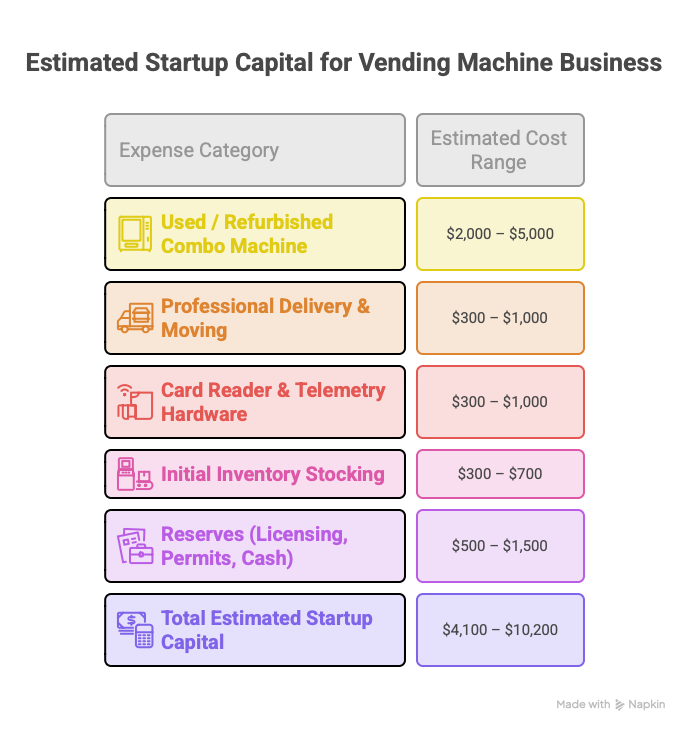
How much money do you actually need to launch? Here is a realistic startup budget for a lean single-machine deployment:
Landed Cost Formula & Pricing Strategies
To protect your margins, calculate the true landed cost of every item before setting prices:
Landed Unit Cost = (Case Cost + Sales Tax + Delivery Fees) / Total Sellable Units
Apply the Doubling Rule to set retail prices. Double or triple your landed unit cost to maintain a target product cost of 40% to 50%. For example, if a cold beverage costs $0.90 landed, price it at $2.00 or $2.25.
Always round retail prices to nickel or quarter increments ($1.25, $1.50, $2.00). This speeds up cash transactions and builds buyer trust.
Structuring Location Commissions
How do you handle location fees? Pitch small offices, warehouses, and local shops on a zero-cost amenity model. Frame your service as a free employee perk that requires zero effort from management.
However, if property managers demand revenue sharing, stick to these gross sales commission tiers:
-
Small Offices & Warehouses: 0% to 5% of gross sales.
-
Apartment Buildings & Corporate HQ: 5% to 15% of gross sales.
-
Hospitals & Medical Centers: 15% to 30% of gross sales.
Yet, never base commissions on net profits—always calculate fees off top-line gross sales. Plus, ensure your combined product cost and location commission never exceed 55% of total gross revenue. Always propose a 90-day trial period at 0% commission to test actual foot traffic before signing a permanent contract.
Licensing, Health Regulations, and Insurance
Operating a compliant vending machine business requires strict adherence to local permits and insurance guidelines. Once you register your business name and entity, there are 3 major areas of licensing you need to be aware of.
Tax and Local Business Licensing
If you sell tangible items or food priced over 15 cents in states like California, you must register for a CDTFA Seller's Permit. One permit covers every machine across your entire business.
Additionally, obtain local municipal business licenses for every city where you place equipment. For instance, operating locally in La Verne requires submitting a municipal business license application with your seller permit number attached.
Public Health Inspections
Do standard machines require health permits? Not always. Machines dispensing shelf-stable, prepackaged snacks and bottled drinks are generally exempt from public health permits.
But if your machines sell perishable items like fresh sandwiches or salads, you must obtain health department approval. This involves submitting equipment spec sheets, product menus, commissary storage permits, and daily cleaning schedules to local health inspectors.
Risk Management and Insurance
Every route operator needs General & Product Liability Insurance to shield against third-party injuries or foodborne illness claims. Expect standard coverage to run around $700 to $800 annually.
What about theft or vandalism? General liability does not cover physical damage to your machines. While specialized Inland Marine policies cover equipment damage, high deductibles cause many operators to cover minor repairs out-of-pocket.
Operations & Smart Recordkeeping
Streamlined operational habits keep your vending machine business efficient and profitable. Applying The 30-30 Rule ensures your route runs like a system rather than a time-draining hobby.
Master Route Optimization with The 30-30 Rule
Route density is the single most critical factor for running a sustainable vending machine business. Under "The 30-30 Rule", your primary objective is simple: never place a machine further than 30 minutes from your home base or central warehouse.
Why is this rule non-negotiable?
-
Drive-Time Drain: A two-hour round trip to fix a minor coin jam or reset a card reader immediately destroys that location's weekly profitability.
-
Service Efficiency: Clustering your locations within a 30-minute radius lets you service multiple locations in a single trip, keeping transit costs minimal and hourly margins high.
Telemetry Software and Smart Pre-Kitting
Modern card readers transmit live telemetry sales data directly to your smartphone, helping you enforce the "30-30 Rule" without extra driving. Telemetry allows you to track real-time inventory levels across your vending machine business.
Instead of making manual inventory inspection trips, generate a precise pick list from your telemetry dashboard. Pack your restock bins in your storage space before hitting the road. This pre-kitting process cuts travel time and servicing labor by up to 50%.
Essential Financial Metrics for Route Tracking
To maintain your 30-30 Rule targets, track these key metrics weekly for every machine in your vending machine business:
-
Weekly Gross Sales: Track cash and card transactions separately.
-
Cost of Goods Sold (COGS): Calculate total wholesale inventory expenses.
-
Credit Card Processing Fees: Account for card processing charges averaging 4% to 5.5%.
-
Location Commissions: Track monthly payouts owed to property owners.
-
Downtime & Spoilage: Log lost income from expired inventory or machine jams.
Marketing and Local Route Acquisition
Acquiring high-traffic locations within your 30-minute radius is the fastest way to expand your vending machine business.
Lead Generation with Google Maps
Skip driving aimlessly around town. Use Google Maps to research industrial parks, warehouses, and commercial complexes within your target territory. Examine satellite imagery to evaluate parking lot density—more cars mean higher employee head counts.
Then, tailor your sales pitch to the specific buyer persona. Pitching a warehouse manager? Emphasize heavy energy drinks and hearty snacks to power through 12-hour shifts. Pitching a medical facility? Highlight healthy options and organic snacks.
Pitching Location Owners
When pitching potential clients for your vending machine business, position your machines as a zero-cost workplace amenity. Walk in and ask strategic qualifying questions::
-
How many employees or daily visitors stay in this facility?
-
What are your primary shift hours?
-
Do you currently have a vending vendor, and what is your team unhappy about with their current service?
Focus on solving existing pain points like empty machines or broken cash validators.
Acquiring Routes from Retiring Competitors
Want to scale your business quickly? Contact established local vending operators in your county. Buying routes from retiring operators offers a fast expansion path for your vending machine business. Many veteran route owners want to scale down or sell out.
Reach out to established operators in your area. You can acquire their underperforming outlier locations or purchase entire routes using seller financing. Replacing outdated cash-only machines with modern smart coolers can double or triple location revenue quickly.
Final Thoughts: Launch Your Vending Route Today
Are you ready to build your route? Secure your first high-traffic location, deploy a modern machine, and start building your financial independence today. Starting a successful vending machine business requires smart location selection, disciplined pricing, and efficient route operations guided by the 30-30 Rule.
By securing local high-traffic locations before buying equipment and leveraging modern telemetry technology, you can build a highly profitable income stream. Ready to get started? Draw your 30-minute radius map today and launch your path to route success!
Social accounts
Get in touch
-
2180 Third Street, La Verne, CA, 91750
-
SBDC@laverne.edu
-
(909)448-1567
Our Newsletter