Decision-Making for Small Businesses: How to Make Smart, Measurable Choices
You wear every hat in your business — owner, marketer, manager, maybe even delivery driver. And every day, you face choices that could change your business: Should you add a new service? Invest in software? Hire help?
Those decisions can feel overwhelming, especially when you’re working with limited time and resources. But here’s the truth — you don’t need a fancy MBA or a team of consultants to make smart, confident decisions. You just need a simple, repeatable process that helps you think clearly and act decisively.
Let’s walk through a friendly, step-by-step method you can use today: S.P.A.D.E., powered by basic ROI and a bit of data. You’ll learn how to define the problem, gather the right input, compare options, decide, and measure results. Ready? Let’s go.
Why Small Business Owners Need a Decision Framework
Every smart decision begins with clarity. The first step of S.P.A.D.E, Setting, is about defining exactly what you’re trying to decide and what you want to achieve. This may sound simple, but it’s the step most business owners rush past.
Too often, we jump straight to solutions before confirming the real issue. For example, you might think, “I need to spend more on advertising,” when the real problem could be poor customer retention or unclear messaging. By slowing down to define your decision precisely, you make sure you’re solving the right problem.
Consider this example:
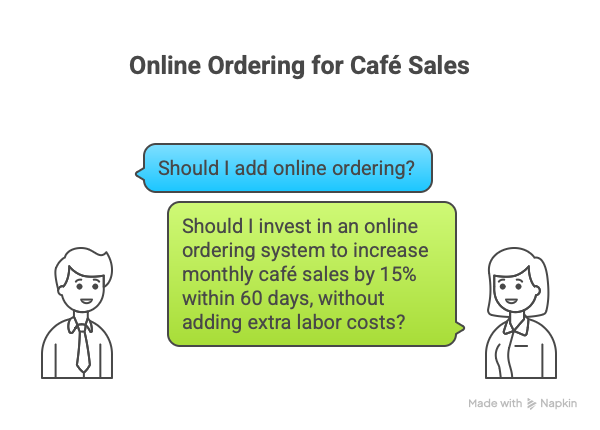
Maria runs a small neighborhood café. Her morning rush is steady, but she notices sales flattening in the afternoons. She’s thinking about adding an online ordering system so customers can order ahead and pick up without waiting.
So instead of asking, “Should I add online ordering?” she reframes it:
“Should I invest in an online ordering system to increase monthly café sales by 15% within 60 days, without adding extra labor costs?”
See the difference? Now the decision is measurable. Maria has a goal (15% sales growth), a time frame (60 days), and a condition (no added labor). That’s the foundation of data-driven decision making — defining what success looks like before you spend a dime.
Try it yourself: What’s the one question you’re trying to answer right now? Write it as a clear sentence with a specific goal and timeline.
Step 1: Setting — Define the Real Problem and the Desired Outcome
Even if you’re the final decision maker, you don’t have to decide in isolation. This step — People — isn’t about getting everyone’s opinion. It’s about getting the right information from the people who experience the problem up close. A quick five-minute conversation can reveal bottlenecks or opportunities you hadn’t noticed.
Back to our example:
Maria knows she’s the final decision maker, but she doesn’t make the call alone. She asks two people for insight — her cashier, who handles most customer interactions, and her barista, who manages daily prep and workflow.
The cashier shares that many customers already ask if they can text or call in orders ahead. The barista notes that making drinks for pre-orders could work smoothly if scheduled properly. These insights give Maria real data about demand and feasibility, not just guesses.
She also checks with her accountant, who tells her the café can afford about $200 per month for any new system.
The goal here isn’t to invite endless debate; it’s to gather relevant facts and first-hand experiences that make the decision more complete. Small business owners can easily get trapped in their own perspective, especially when working with a tight-knit team. Including others in the process reinforces accountability and creates buy-in when the decision is implemented.
Step 2: People — Involve the Right Voices Without Losing Control
Even if you’re the final decision maker, you don’t have to decide in isolation. This step — People — isn’t about getting everyone’s opinion. It’s about getting the right information from the people who experience the problem up close. A quick five-minute conversation can reveal bottlenecks or opportunities you hadn’t noticed.
Back to our example:
Maria knows she’s the final decision maker, but she doesn’t make the call alone. She asks two people for insight — her cashier, who handles most customer interactions, and her barista, who manages daily prep and workflow.
The cashier shares that many customers already ask if they can text or call in orders ahead. The barista notes that making drinks for pre-orders could work smoothly if scheduled properly. These insights give Maria real data about demand and feasibility, not just guesses.
She also checks with her accountant, who tells her the café can afford about $200 per month for any new system.
The goal here isn’t to invite endless debate; it’s to gather relevant facts and first-hand experiences that make the decision more complete. Small business owners can easily get trapped in their own perspective, especially when working with a tight-knit team. Including others in the process reinforces accountability and creates buy-in when the decision is implemented.
Step 3: Alternatives — Weigh the Options Using ROI
The Alternatives stage is where the S.P.A.D.E. framework shines for small businesses. This is your opportunity to pause, step back, and consider multiple paths before committing to one.
Armed with insights, Maria from our example lists three options:
• Use a delivery app (like DoorDash or Uber Eats). No setup cost, but the platform takes a 20% commission on each order.
• Build her own online ordering page through her POS system. A $300 setup fee and $25 monthly cost, but full control over pricing.
• Do nothing for now and instead focus on social media promotions to attract more foot traffic.
Most business owners tend to default to the most familiar or fastest option. But decisions grounded in ROI — Return on Investment — force you to look deeper. ROI gives you a simple question to answer: Which option gives me the best return for the time, money, and effort I invest?
To apply this practically, start by identifying your top two or three realistic alternatives. For each one, estimate the cost, time required, and expected benefit.
She estimates potential revenue for each option:
• The delivery app could bring in about $1,000 in new monthly sales but cost $200 in commissions.
• The self-built page could generate $800 in new sales for about $25 a month.
• The social media push might add $400 in sales but require more of her time.
Using simple math, she calculates basic ROI using the formula: (Gain - Cost) / Cost x 100
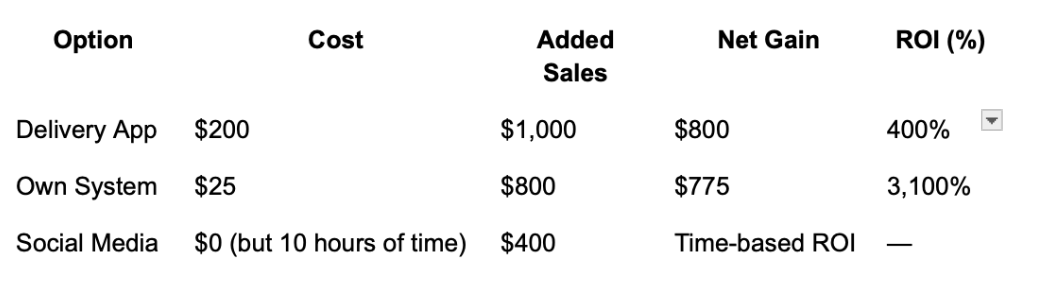
This exercise isn’t about being perfect with numbers — it’s about clarifying which choice gives you the greatest overall impact. It moves you away from emotional decision making and toward practical, measurable reasoning.
You can also apply ROI to non-financial outcomes such as time saved or error reduction. In a small business, time truly is money, so efficiency gains can be just as valuable as direct revenue growth.
Step 4: Decide — Make the Call with Confidence and Data
Once you’ve compared your options, it’s time to make the decision. For many business owners, this is the hardest step — not because they lack information, but because they fear making a mistake. Yet hesitation often costs more than a wrong choice. Delays create lost opportunities, confusion for your team, and slower progress.
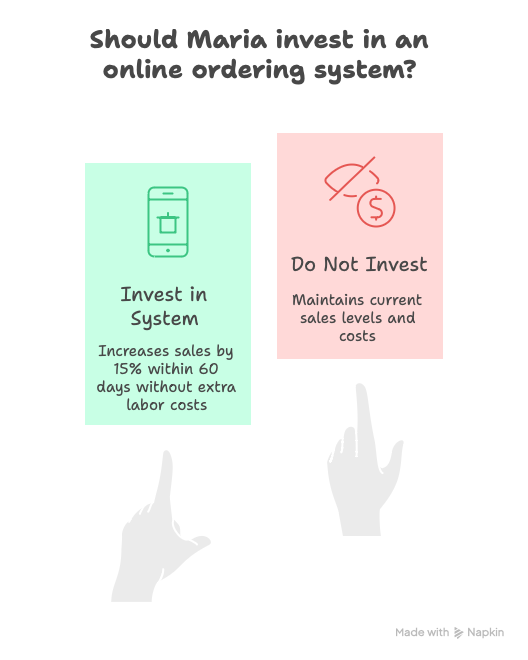
Now that Maria has compared her options, she’s ready to decide. She chooses to invest in the café’s own online ordering page. The setup fee feels like a risk, but the high ROI and full control over branding make it worthwhile.
And here’s the key: she doesn’t treat this as a permanent decision. She treats it as a 60-day test.
By giving herself permission to experiment, she removes the pressure of being “right.” Instead of worrying, she commits to tracking data — weekly online orders, new customers, and total sales.
That’s how small businesses evolve intelligently, not reactively.
Step 5: Explain — Communicate and Measure the Results
The final step, Explain, is about closing the loop. Once a decision is made, take time to record what you decided, why you chose it, and how you’ll know it worked.
If you lead a team, explain your reasoning clearly. Transparency builds trust and alignment. Team members are far more likely to support a plan when they understand its purpose. If you’re a solopreneur, document your reasoning for your own reference. This habit of reflection becomes a record of your decision-making growth over time.
How does this work for our example?
Maria announces the decision at her weekly staff meeting. She explains that they’ll test online pickup for 60 days to see if it increases sales and reduces wait times. She walks through what success looks like and how the team will track progress — using simple metrics: total online orders, sales growth, and customer feedback.
Then, measure the outcomes. Track whatever metrics connect most directly to your original goal — sales growth, lead conversions, hours saved, or customer satisfaction. Compare the actual results to your expectations and calculate your ROI. This process transforms each decision into a learning opportunity. You not only know whether it worked, but *why*.
Back to our example:
After two months, Maria reviews the numbers. Online orders have grown steadily, and monthly sales are up 18%. Labor costs stayed flat because the team managed orders efficiently. She exceeded her goal and built a repeatable model for future decisions.
If the results fall short, revisit the earlier steps. Was the problem defined correctly? Did the data fully capture the situation? Were there alternative factors you missed? Each review strengthens your future judgment.
Why S.P.A.D.E. with ROI and DDDM Works for Small Businesses
The S.P.A.D.E. framework isn’t about adding red tape to your business. It’s about giving you confidence and clarity. You take big, messy problems and break them into small, manageable steps — define the goal, talk to the right people, weigh your options, decide, and measure.
And when you layer in simple ROI thinking and a bit of data, decisions become measurable. You stop asking, “Did this work?” and start knowing.
Every time you follow this process, you build stronger instincts — not because you guess better, but because you learn faster.
Final Thoughts
Effective decision making for small businesses isn’t about being fearless or flawless; it’s about being focused. The S.P.A.D.E. framework helps you bring clarity and logic to choices that once felt overwhelming. When paired with ROI and data-driven thinking, it transforms decisions into a continuous improvement process that fuels long-term success.
Every business choice — from marketing campaigns to hiring — can be approached as a mini-experiment. Define the decision clearly, gather the right input, compare the options logically, commit confidently, and measure the results. Over time, this habit creates a culture of informed action rather than reactive guessing.
The beauty of S.P.A.D.E. is that it fits the rhythm of small business life. It respects your time, leverages your instincts, and adds structure without red tape. Whether you’re a solopreneur or leading a small team, you’ll find that once you apply it a few times, it becomes second nature — a built-in way of thinking that makes you a sharper, more confident leader.
Because the truth is simple: successful small businesses aren’t built on perfect decisions; they’re built on consistent, measurable, and well-informed ones.
Social accounts
Get in touch
-
2180 Third Street, La Verne, CA, 91750
-
SBDC@laverne.edu
-
(909)448-1567
Our Newsletter