Picking a Business Partner Without Regret
You have likely seen the data. Most startups don't die because the market wasn't ready or the product was flawed. They died because the founders couldn't stop fighting.
The single biggest point of failure in any new venture is the team. Specifically, it’s the hasty, emotion-driven decision of picking a business partner.
Too many founders treat this process like a marriage proposal, relying on "vibes" and social chemistry. You pick the person you like having a beer with. You pick your college roommate. You pick your brother.
But a business partnership isn't a marriage; it is a high-stakes executive hiring decision. And mistaking shared excitement for execution ability is a fatal error.
You need to stop relying on your gut. You need a protocol. Here is how you move from a handshake deal to a structured selection process that ensures your company survives the "founder divorce" statistics.
Why You Would Need a Business Partner to Begin With
Before we even discuss who to pick, let’s have a candid conversation about why you are looking.
Are you actually missing a critical skill? Or are you just lonely?
Entrepreneurship is isolating. It is incredibly tempting to bring someone on board just to share the psychological burden. But picking a business partner solely for emotional support is a strategic error. That is what mentors, therapists, and advisory boards are for. A partner is for execution.
You should only consider splitting your equity for three specific reasons:
The Skill Gap: You are a technical wizard who can build the product, but you freeze up during sales calls. Or you are a marketing genius who can’t write a line of code. You need a partner to do the work you literally cannot do.
Speed to Market: In a winner-take-all market, speed is your primary weapon. Two high-performing founders can move twice as fast as a soloist. If your runway is short, a partner acts as a force multiplier.
Capital and Credibility: Sometimes, the gap is financial. You have the time and the talent, but you lack the capital to fund inventory or the credit score to sign a commercial lease.
However, if you can hire a freelancer or an employee to fill these gaps, do that instead. Equity is the most expensive currency you will ever spend. Don’t spend it unless it is absolutely essential to the core survival of the business.
What Are You Supposed to Look for in the "Right" Business Partner?
If you have determined that a co-founder is necessary, you must now define the role. And you must avoid the "Clone Trap." The most comfortable mistake in picking a business partner is selecting someone just like you. If you are a creative visionary, you naturally gravitate toward other visionaries.
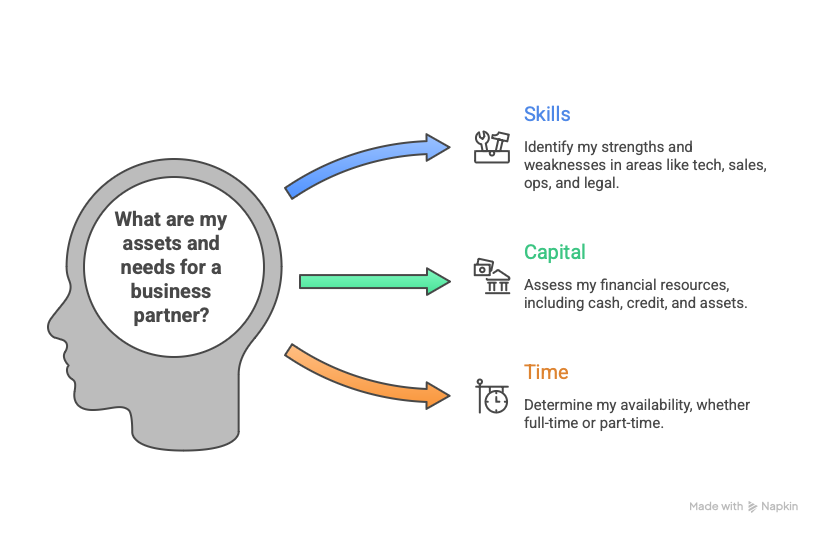
But you don’t need another you. You need a counterbalance. To find the right fit, conduct a ruthless self-audit. Categorize your assets into three buckets:
Skills: (Tech, Sales, Ops, Legal)
Capital: (Cash, Credit, Assets)
Time: (Full-time vs. Part-time)
Shared Values are Non-Negotiable
While skills should be opposite, values must be identical. You need to align on the "North Star" questions immediately:
Work Ethic: Are you grinding 80 hours a week while they want a "lifestyle business"?
Risk Tolerance: Are you willing to personally guarantee a loan, or are they terrified of debt?
Ambition: Do you want to sell to Google for $100M, or do they want to run a profitable shop that pays for their boat?
Misalignment here isn't a compromise. It’s a ticking time bomb.
How to Find a Business Partner
Now that you have the avatar, you have to go hunting. Picking a business partner is a numbers game, and you need a funnel.
Start with your "warm" network. Former colleagues are your highest-quality leads because you have "field data" on them. You know how they handle stress. You know if they deliver on deadlines.
If your network is dry, you must go where the talent lives.
• Industry Events: Don't just network; look for the people asking the smart questions at the mic.
• Hackathons: If you need a technical lead, go see who is shipping code under pressure.
• Co-Founder Platforms: Tools like Y Combinator’s Co-Founder Matching service can broaden your reach beyond your local zip code.
Avoid the Committee
Be careful of the "Entourage Effect." Sometimes, a group of five or six friends wants to start something together. But if you can’t write a distinct, one-page job description for a specific person, they shouldn't be a partner.
If two people have the same job description, one is redundant. Eliminate the redundancy before you sign the paperwork.
How to Evaluate a Business Partner
You found someone promising. They have the resume. They have the capital. Now, you must verify.
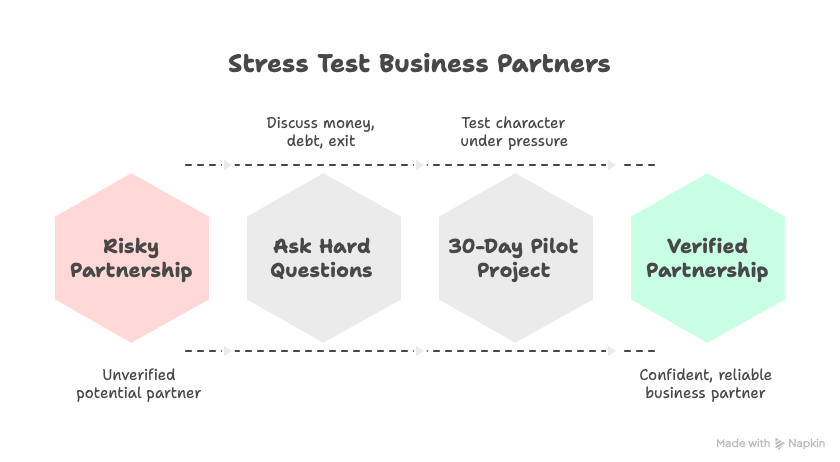
Picking a business partner requires you to move from polite conversation to a "stress test."
Ask the Hard Questions First
Discuss money, debt, and exit goals in the very first serious meeting. If they are "too polite" to talk about money now, they will be a nightmare when cash flow gets tight. Ask them:
• "How long can you realistically go without a salary?"
• "What is your personal credit score?"
• "If we get a buyout offer for $5 million next year, do we sell or double down?"
The 30-Day Pilot Project
Here is the golden rule: Date before you marry.
Never sign legal papers based purely on a conversation. Agree to a 4-week, time-boxed pilot project. Launch a landing page, build a prototype, or run a marketing sprint.
You aren't just testing their output. You are testing their character under pressure:
• Do they miss deadlines?
• Do they hide bad news?
• Do they blame others when things go wrong?
This is cheap insurance. It is infinitely better to find out your partner is lazy during a 30-day trial than after you’ve given them half your company.
Structuring the Business with Partner(s)
You have selected the person. Now you must build the "prenup." Legal entities don't fix character flaws, but they limit the damage a bad partner can do.
Entity Selection
Avoid the "Accidental Partnership." If you start working without paperwork, the law often defaults you to a General Partnership. This means you have unlimited personal liability for your partner's mistakes. If they crash the company car or take out a bad loan, the bank can come after your house.
• LLC: Great for flexibility and tax protection.
• C-Corp: Essential if you plan to raise Venture Capital.
Governance and Control
Ownership does not equal control. If you have multiple partners, do not rely on "unanimous" voting. It creates deadlock. You need a hierarchy. Establish a Board structure for big decisions (selling the company) and a CEO structure for daily operations.
A Vesting Schedule
When picking a business partner, you must assume they might leave. Never give 100% equity upfront. Use a standard 4-year vesting schedule with a 1-year cliff.
• The Cliff: If a partner quits or is fired within the first 12 months, they walk away with nothing.
• The Vesting: After year one, they earn their shares monthly.
This aligns incentives and ensures everyone is committed for the long haul.
Red Flags to Avoid
If you spot these signs during your evaluation, do not proceed. Walking away now is cheaper than a lawsuit later.
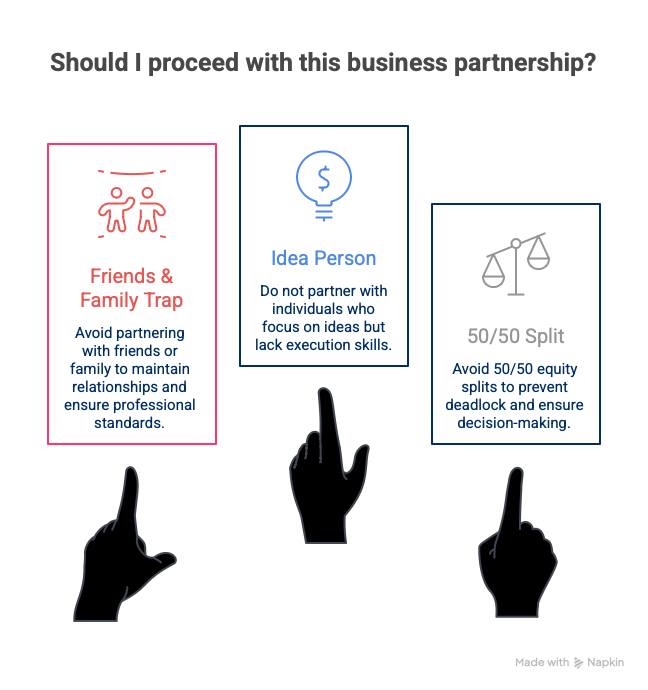
The "Friends & Family" Trap
This is the most dangerous trap in picking a business partner. You trust them socially, so you assume you can trust them professionally.
But you must apply the "Stranger Standard." Ask yourself: "Would I hire them for this role if we weren't related?" If the answer is no, do not partner. You risk losing both your business and your relationship.
The "Idea Person"
Beware of partners who want equity for the "concept" but refuse to do the work. Ideas are cheap; execution is expensive. If they focus on "Productivity Theater"—designing logos and business cards—but refuse to make sales calls, they are dead weight.
The 50/50 Split
Splitting equity 50/50 to "be nice" guarantees deadlock. If you disagree on a critical decision, who breaks the tie? Assign a tie-breaker vote or use an odd-number split (e.g., 51/49). Someone must have the final say to keep the ship moving.
The Bottom Line
Picking a business partner is about risk mitigation. It requires you to be logical, not emotional.
Look for complementary skills. Verify them with a pilot project. Protect yourself with a vesting agreement. A strong founding team is the bedrock of a successful company—but a bad partner is worse than no partner at all.
Better to go solo and hire help than to tether yourself to the wrong co-founder. So, take your time, follow the protocol, and build a team that can actually go the distance.
Social accounts
Get in touch
-
2180 Third Street, La Verne, CA, 91750
-
SBDC@laverne.edu
-
(909)448-1567
Our Newsletter