Can I Afford to Hire an Employee? Here’s How to Know
Feb 25
/
Joshua Botello
Empty space, drag to resize
Thinking about expanding your team? Hiring your first employee can feel like a major milestone. In the back of your mind, you might be asking yourself, “Can I really afford this?” Most business owners confuse affording a hire for one month with being able to sustain that hire long-term.
Hiring someone isn’t just about paying a salary—it’s about building a foundation for growth. This is the “Payroll Iceberg.” The base salary is the tip you see—but below the surface are the mandatory and often invisible costs that can sink your budget if not accounted for. And before you make that leap, you need to know your numbers, your goals, and your financial readiness.
Step 1: Know the Real Cost of Hiring
Here’s where many small business owners get caught off guard. They think, “If I pay $20 an hour, that’s all it costs.” Not quite.
Most business owners only see the tip of the iceberg—the base salary. But beneath the surface lies a chunk of hidden costs that can quietly sink your budget if you’re not ready for them.
Key Components of the Submerged Cost
Here’s what you need to add to the base salary:
• Mandatory Payroll Taxes: Social Security, Medicare, federal/state unemployment (FUTA/SUTA) and other employer taxes.
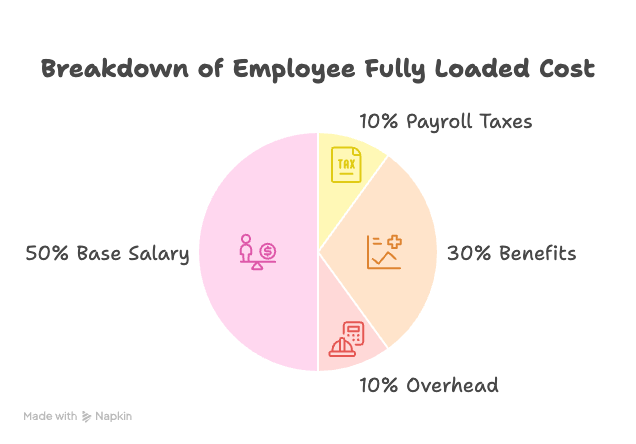
• Benefits & Compensation: Health insurance, retirement/401(k) matching, paid time off. Often about 30% of total cost.
• Operational Overheads: Equipment, computers, software licenses, workspace (even for remote staff), remote‐work stipends.
• Training & Development: Onboarding, training materials, professional development, the recruiter cost and ramp-up time.
• Other Hidden Costs: Turnover costs, lost productivity during ramp-up, extra supervision, compliance & legal overhead.
On average, the real cost of an employee is about 1.25 to 1.4 times their base salary. So, if you plan to pay $40,000 a year, the true cost might be closer to $50,000–$56,000.
Bottom line: When you’re asking can I afford to hire an employee?, ask not only “Can I cover the salary?” but “Can I cover the full iceberg?”
Step 2: Check Your Current Cash Flow
Let’s be honest—cash flow tells the real story. Your business needs more than optimism—it needs measurable readiness. Pull out your bank statements or open your accounting software. Here are four key metrics:
1. Consistent Positive Cash Flow (The Cash Generator)
You need to generate more cash than you spend—consistently. Your Operating Cash Flow Ratio should ideally be above 1.25, meaning you’re bringing in $1.25 for every $1 owed. Let’s calculate it:
Operating Cash Flow:
Net Income + Non Cash Expenses (Depreciation/Amortization) +/- Changes in Cash flow
Net income is the company's after-tax profit from its income statement then add back non-cash expenses like depreciation and/or amortization to the net income.
A hire adds ongoing cost; if you don’t have a cash buffer, you’ll feel the squeeze.
2. Profit Margin Stability (The Flexibility Test)
How much money consistently stays in the business after you pay yourself and your bills? Let’s figure it out:
Operating Profit = operating income/(Earnings Before Interest and Taxes)
Net Sales = Gross Sales(Revenue) - (Returns + Discounts + Allowances)
Return on Sales = Operating Profit/Net Sales x 100
Your minimum Operating Margin (Return on Sales) should be above about 10–15% to safely absorb extra cost. Without margin, a new hire could push you into break-even or loss territory.
3. Liquidity Health (The Short-Term Safety)
Even profitable businesses can get tripped if short-term liabilities stack up. Your businesses Current Ratio (current assets ÷ current liabilities) from your balance sheet, needs to be above 1.2.
This metric ensures you can cover short-term bills—including the new hire’s payroll.
4. Revenue Predictability: Your Cash Runway
A spike in revenue won’t sustain a hire if it’s one-off. You need repeatable, stable cash inflows—not just a big month. Here’s a quick trick: Multiply your average monthly surplus by three. That’s your cash runway or how many months you could pay an employee even if your revenue dips. Even if you can afford to hire, timing matters. Here’s how to approach it.
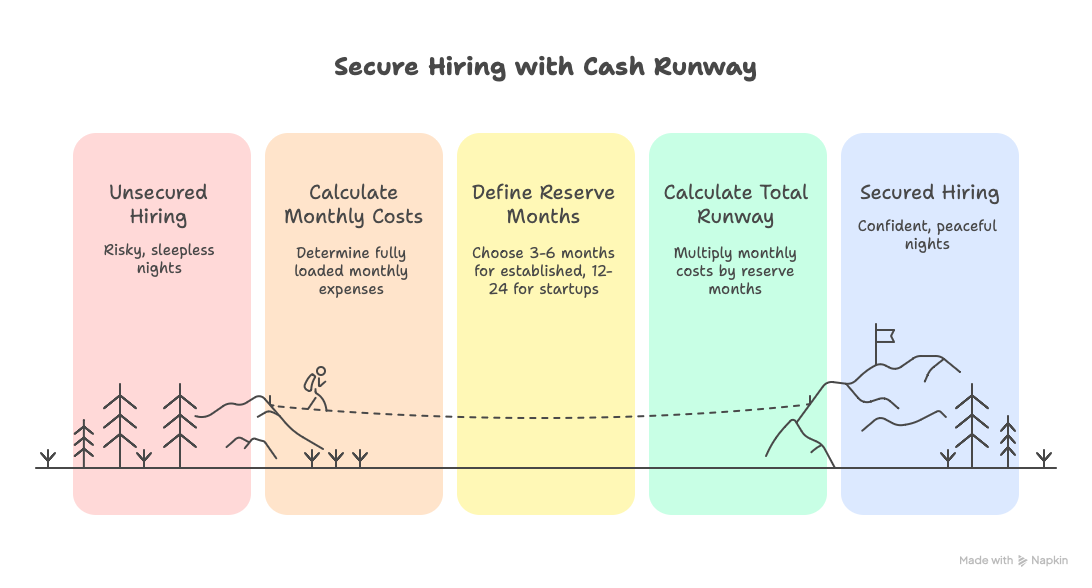
(Fully Loaded Monthly Cost of New Hire) × (Required Months) = Total Cash Reserve Needed
• For small-medium businesses: aim for 3–6 months of the fully loaded cost saved.
• For startups or higher-risk scenarios: consider 12–24 months or more depending on industry and funding cycles.
Even with reserves, ask: Is the hire necessary now?
Look for signs of your hiring need like sustained backlog, turning away paying work, team burnout. If you don’t have this demand, the cost may outweigh the benefit. Having a solid runway means you can weather slow periods without the new employee becoming a drain.
Step 3: Estimate Your Break-Even Point
This part involves a little math—but stick with me, it’s simpler than it sounds. Your break-even point is the amount of revenue your new employee needs to help generate, either directly or indirectly, to cover their total cost. Here’s the formula:
Total Employee Cost / Profit Margin = Employee Breakeven
($50,000) / (0.25) = $200,000
For example, if your employee costs $50,000 a year and your profit margin is 25%, then you’ll need $200,000 in additional revenue to cover their cost.
Ask yourself—does that number feel realistic within the next 6 to 12 months? If yes, you might be ready to move forward. If not, maybe consider hiring part-time or using a contractor first.
Step 4: Consider the ROI—Return on Impact
Hiring isn’t just about money—it’s also about time, energy, and growth. When you get down to the final question of “how to know if I can afford to hire an employee?”, ask: Will this person pay for themselves?
Think about what tasks this person will take off your plate. How will that free you up to focus on higher-value work? Will this new role help you increase revenue, expand capacity, or increase efficiency/reduce costs?
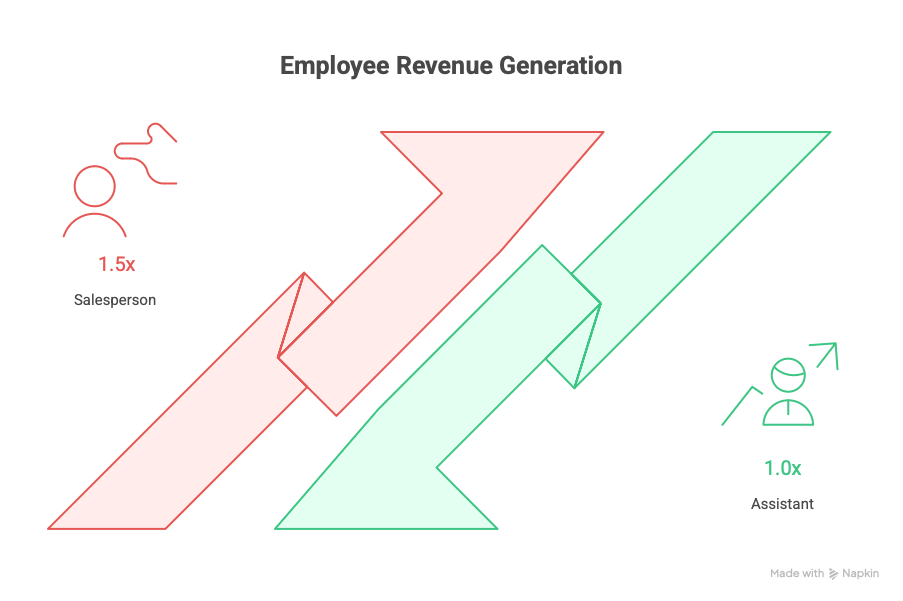
Now, sometimes the return shows up fast—like hiring a salesperson who brings in new clients right away. Other times, it’s slower—like hiring an assistant who gives you back hours you can reinvest in growing the business.
The goal isn’t simply to afford an employee; it’s to use that hire strategically so your business earns more than it spends. You should expect the hire to begin paying for themselves within 6–12 months.
Here is the Break-Even Test:
The employee should generate at least their total cost within a year. If your gross margin is 65%, the hire may need to generate ~1.5× their cost in new revenue. Perform a pro-forma projection—estimate sales or efficiency gains before committing to the hire.
If you can’t show a clear path to ROI, the hire may be more of a liability than an asset. Either way, the key is to track how that decision impacts your bottom line over time.
Create a Financial Projection
Estimate your costs and sales before you hire in this in-depth course
Step 5: Test it out for yourself
Here’s where you pull everything together. Download the Financial Readiness Worksheet for Your First Hire (created for this post) and work through it step by step. The worksheet helps you calculate the total cost of hiring, review your financials, measure your cash runway, and estimate your ROI before you commit.
Sometimes seeing the numbers on paper—or on screen—makes everything click.If you’re still unsure, you don’t have to go all in right away. You can ease into hiring.
Try starting with a part-time position or a contractor arrangement. You could even offer a 90-day trial period before making the role permanent.
This approach gives you a chance to adjust your budget and see how having help actually changes your workload and results. It’s like dipping your toes in before diving in headfirst.
Final Thoughts
Hiring your first employee is a big move, but it doesn’t have to be a scary one. It’s not about guessing; it’s about planning.
When you understand your true costs, keep an eye on your cash flow, and map out the return you expect, you’ll be able to say with confidence, “Yes, I’m ready.”
Because at the end of the day, you’re not just hiring an employee. You’re building a stronger version of your business—one that’s ready to grow.
Ready to hire? Check How Create Your Job Description
Empty space, drag to resize
Funded in part through a Cooperative Agreement with the U.S. Small Business Administration. All opinions, conclusions, and/or recommendations expressed herein are those of the author(s) and do not necessarily reflect the views of the SBA.